The history and myths of Crete, cradle of Minoan civilization
The origins of European civilization
Crete is often referred to as the cradle of European civilization. In fact, around 2700 BC, the Minoan civilization was born here, profoundly influencing Mediterranean history. Its majestic palaces, such as Knossos, Phaistos, Malia and Zakros, bear witness to a refined, seafaring, trading people. These cities, linked by a vast network of exchanges, contributed to making the island a major cultural center of its time.
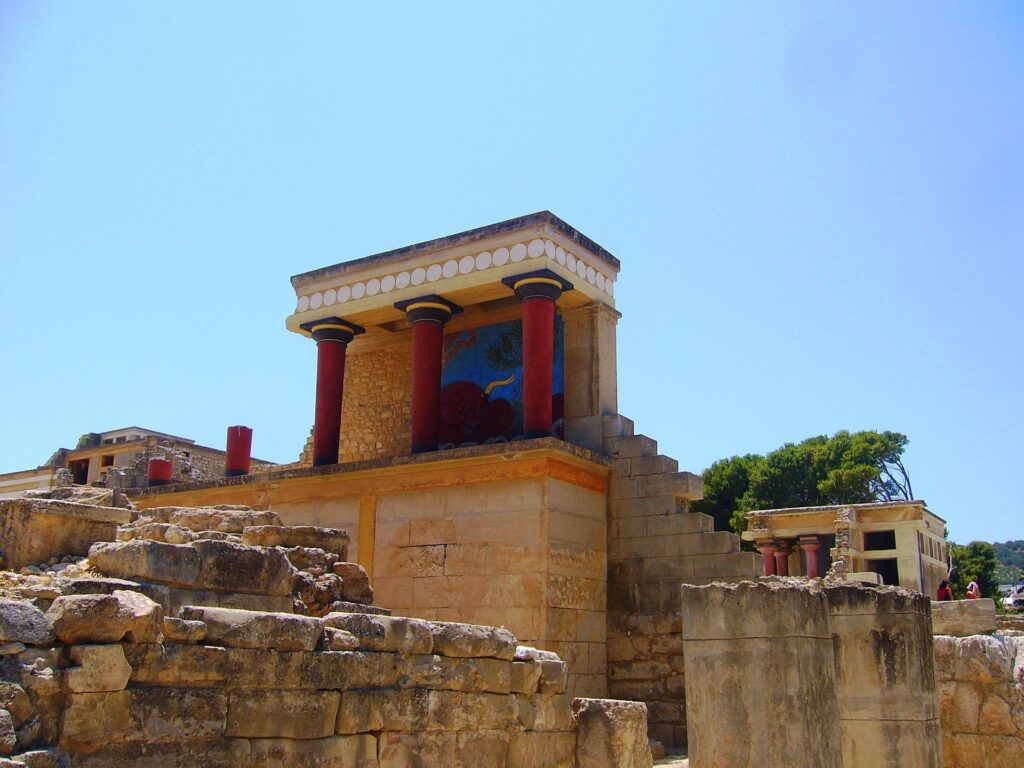
The palace of Knossos, partially restored by British archaeologist Arthur Evans, reveals brilliant frescoes and architecture of astonishing complexity. Today, it is one of the most visited archaeological sites in Greece. The Minoans also lived in harmony with their environment, a sign of a lifestyle that was both spiritual and pragmatic. They had already mastered advanced irrigation, craft and navigation techniques, while their frescoes told of the beauty of the world around them. In this way, ancient Crete embodies a civilization that was innovative, seafaring and profoundly human.
The cradle of Zeus and the myth of the Minotaur
Crete occupies a central place in Greek mythology. According to legend, Zeus, king of the gods, was born in the cave on Mount Dikte, on the Lassithi plateau. His mother, Rhea, hid him there to save him from his father Cronos, who devoured every one of his children. This sacred site, which is still accessible, attracts many visitors every year, fascinated by its stalactites and mystical atmosphere. Even today, the Lassithi region retains the divine aura that links nature with spirituality.
Another equally famous founding myth is that of the Minotaur, the half-man, half-bull monster trapped in King Minos’ labyrinth. According to tradition, this story was inspired by the complexity of the Knossos palace, whose maze-like layout evokes the corridors of a labyrinth. What’s more, the story illustrates not only the power of King Minos, but also the symbolic creativity of ancient Crete. So, between legend and archaeology, the island is a reminder of the harmonious blend of myth and reality.
An enduring spiritual and cultural heritage
These tales, handed down for over three millennia, still nourish the Cretan identity today. Indeed, mythology still influences local festivals, traditional music and popular arts. The symbols of the labyrinth, the bull and the Olympian gods can be found on pottery, jewelry and wall decorations. In the museums of Heraklion and Rethymnon, you can admire numerous artifacts from Minoan excavations, testifying to an exceptional cultural continuity. This heritage links ancient Crete to modern Greece and represents a living bridge between legend and history, spirituality and everyday life.
The wilderness of Crete, between mountains and gorges
A Greek island shaped by nature
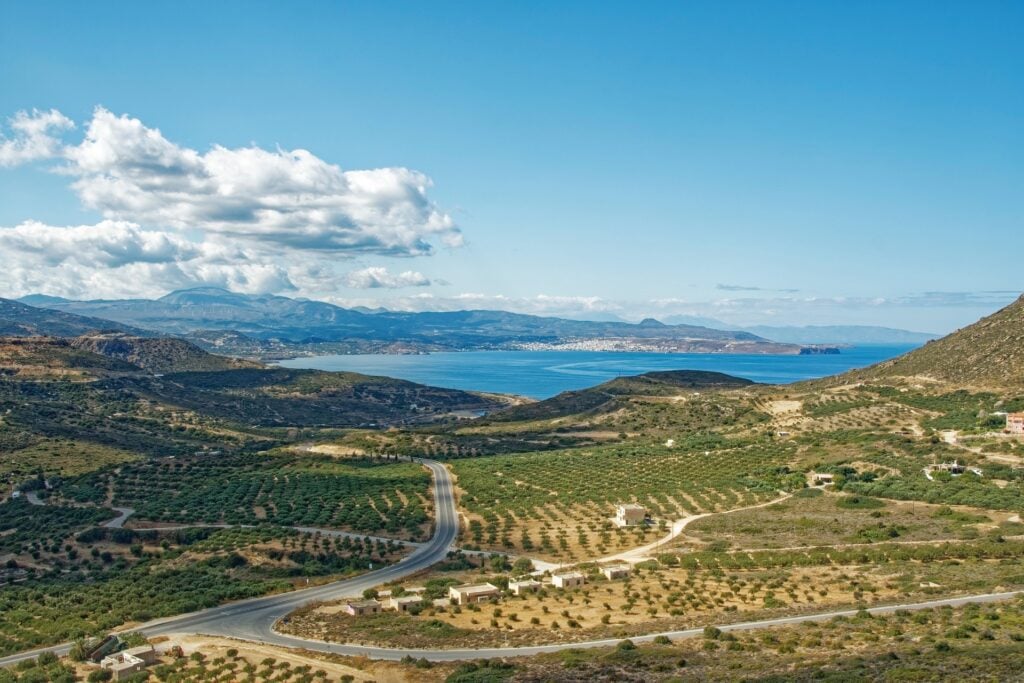
Crete is distinguished by its spectacular geography. Situated between the Aegean and Libyan Seas, it is the largest of the Greek islands. Its elongated shape stretches for over 250 kilometers, revealing an alternation of fertile valleys, arid plateaus and mountain ranges. The White Mountains, Mount Ida and the Lassithi massif dominate the central landscape. These abrupt reliefs protect an exceptional Mediterranean flora of thyme, oregano, laurel and thousand-year-old olive trees.
Mount Ida, also known as Psiloritis, rises to 2,456 metres and remains the highest peak in Crete. It is home to several mythical caves, including the one where, according to legend, Zeus was raised. These mountains mark the boundary between the more popular north Crete and the wilder south.
The secret gorges and valleys of Crete
Crete boasts over 400 gorges, some of which are accessible all year round. The most famous are the sixteen-kilometer-long Samaria Gorge, located in the national park of the same name. Classified as a biosphere reserve by UNESCO, they offer a spectacular itinerary between vertiginous cliffs and pine forests.
Other sites, such as the Imbros,Aradena orAgia Irini gorges, offer shorter but equally stunning hikes. These paths, often lined with wild flowers, lead to remote villages or isolated coves. Each valley is home to a unique biodiversity, where birds of prey, wild goats and endemic plants live side by side.
A Mediterranean climate between sea and mountains
The Cretan climate remains one of the mildest in Europe. Winters are short, summers long and dry. Coastal areas enjoy a constant sea breeze, while the mountains remain pleasantly cool. This combination of microclimates favors the cultivation of olives, vines and citrus fruits.
In spring, the island is covered in wild flowers, and the paths are fragrant with rosemary. In autumn, the landscape takes on golden hues, offering a particularly soft light. Cretan nature, ever-changing and alive, has been the daily rhythm of its inhabitants for thousands of years.
Crete's beaches: turquoise lagoons and secret coves
Crete's not-to-be-missed beaches
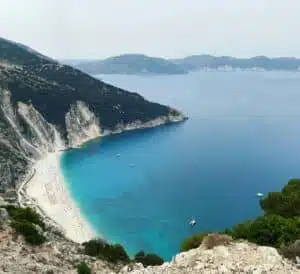
Crete boasts some of the most beautiful beaches in Greece. The most impressive panoramas are to be found to the west.
Elafonissi
Its pinkish sand and shallow turquoise lagoons are fascinating. The contrast between sea and mountains creates an almost unreal landscape. Very busy in summer, it remains a magical place at sunrise.
Balos Beach
Situated on the Gramvoussa peninsula, it boasts crystal-clear waters in every shade of blue. Access on foot offers spectacular views of the lagoon and arid hills.
Falassarna
A beach that stretches for several kilometers and offers magnificent sunsets. The sand is fine and golden, and bathing is always pleasant thanks to the clear, temperate water.
On the north coast, the beaches are more accessible and often family-friendly.
Agia Pelagia
Close to Heraklion, it attracts visitors with its calm waters and wind-protected bay. Seaside tavernas serve delicious Cretan dishes.
Mononaftis
Located just off Agia Pelagia, it’s a rocky cove ideal for snorkeling. The water is clear and full of marine life, perfect for a peaceful swim.
These beaches represent Crete at its best: breathtaking scenery, easy accessibility and a Mediterranean vacation atmosphere.
Crete's unspoilt beaches
As you venture further south, Crete reveals a more secretive side. The coasts bordering the Libyan Sea are home to secluded beaches, often only accessible on foot or by boat.
Preveli
This beach remains one of the most emblematic. It is crossed by a freshwater river and bordered by a natural palm grove. The contrast between the greenery and the intense blue of the sea is spectacular.
Agiofarago
Nestled at the bottom of a canyon, it can be discovered after a forty-minute walk. Surrounded by sheer cliffs, it offers a wild and peaceful setting, perfect for unwinding.
Kato Zakros
On the southeast coast, it combines relaxation and history. Visitors can explore the ruins of an ancient Minoan palace before enjoying a swim in the crystal-clear sea.
As you venture further south, Crete reveals a more secretive side. The coasts bordering the Libyan Sea are home to secluded beaches, often only accessible on foot or by boat.
Further east, Crete hides other natural treasures.
Xerokampos
This beach offers a succession of small coves sheltered from the wind, ideal for those seeking absolute silence.
Vai
Located at the eastern end of the island, is famous for its palm forest, the largest in Europe. The contrast between the bright green of the trees and the deep blue of the Aegean Sea creates a unique tropical atmosphere.
These less-frequented beaches are seductive in their authenticity. They are a reminder that Crete is more than just a tourist destination: it is above all a haven for lovers of nature and freedom.
Crete's history and cultural heritage
An island shaped by civilizations
The history of Crete spans more than five millennia. After the brilliant Minoan civilization, considered to be the oldest in Europe, the island experienced many influences. First the Mycenaeans, then the Romans, marked its urban and commercial development. Later, the Byzantines introduced the Christian faith and built many of the monasteries still visible today.
From the XIIIᵉ century onwards, Crete came under Venetian rule. This period leaves a strong imprint: coastal fortresses, loggias, sculpted fountains and Gothic buildings. The towns of Chania, Rethymnon and Heraklion still bear this elegant architecture, blending Venetian art and Greek traditions. In the XVIIᵉ century, the Ottomans took control of the island. They influenced the island’s cuisine, craftsmanship and certain place names. Full independence was not achieved until 1913, when Crete joined modern Greece.
Each era has enriched the local heritage, creating a unique cultural identity. In museums such asHeraklion‘s, you can admire Minoan frescoes, Venetian pottery and Byzantine religious objects. Crete is a veritable open-air history book.
A living heritage of art, faith and tradition
Cretan cultural heritage is not limited to ancient vestiges. On the contrary, it expresses itself every day in the lives of its inhabitants. For example, traditional dances such as syrtos and pentozalis punctuate local festivals. And music, played on the lute and lyra, evokes the island’s freedom and pride. Everywhere, religious celebrations combine fervor and hospitality, often accompanied by communal meals shared in a convivial atmosphere.
Craftsmanship, too, remains a pillar of Cretan culture. Even today, ancient pottery, fine embroidery and hand-crafted stringed instruments are still produced here. The Venetian influence can be seen in the frescoes of the churches, while Ottoman motifs can be seen in the architecture and fabrics.
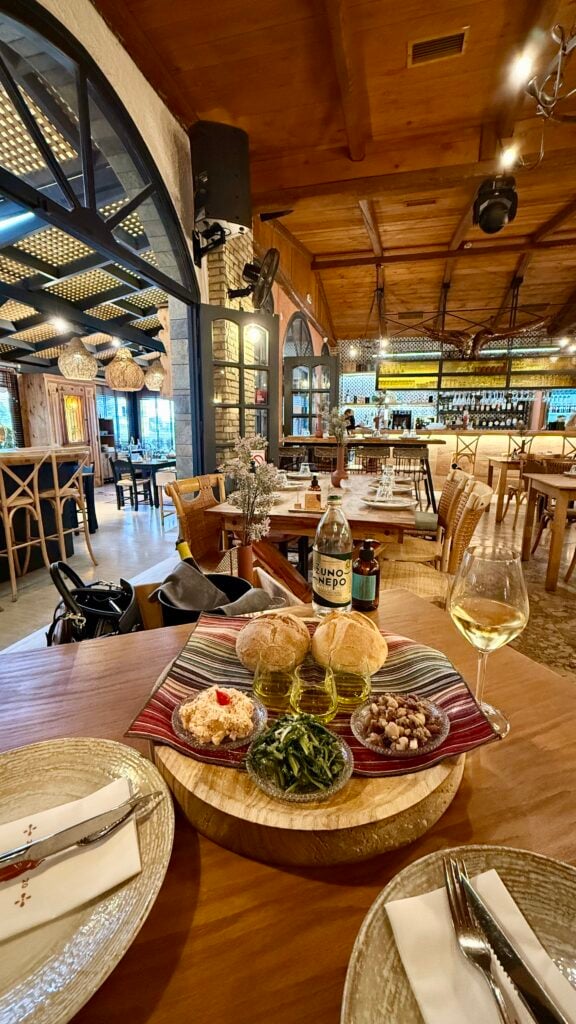
This cultural richness also extends to gastronomy, considered a true intangible heritage. Recipes are handed down from generation to generation: olive oil, wild herbs, graviera cheese, thyme honey. In this way, every meal becomes a way of preserving the collective memory. Crete, between past and present, embodies more than ever the harmonious union between tradition and modernity.
Cretan villages and traditions
Crete's villages, guardians of authenticity
Far from the tourist areas, Crete can be discovered through its villages, where time seems to stand still. Each region has its own character and tells a different story.
Vamos and Douliana (west)
Stone houses, flower-filled lanes and a typically Cretan atmosphere. You can breathe in the serenity and the smell of warm bread.
Anogeia (center)
Perched on the slopes of Mount Psiloritis, this village embodies Cretan pride. Renowned for its resistance during the Second World War, it is also a musical Mecca.
Kritsa and Mythoi (south)
Peaceful villages surrounded by olive groves and monasteries. Narrow streets lead to shady courtyards, where locals are happy to exchange a few words with visitors.
In these villages, Greek coffee and a glass of raki are never just drinks. Above all, they are gestures of welcome and sharing. Cretan hospitality, handed down from generation to generation, remains deeply rooted in everyday life. In the kafeneia, locals get together to talk about the olive harvest, the weather or upcoming festivities. It’s not unusual for a visitor to sit down at their table, spontaneously invited to join in the conversation. These simple moments reflect the conviviality of an island where the human bond retains all its value.
Cretan festivals, music and crafts
Traditions punctuate the year and maintain the link between past and present. For example, each village celebrates its panigyria, or patron saint’s day, when music, dance and communal meals bring the whole community together.
As the seasons go by, these celebrations become real landmarks, uniting generations around the same fervor.
Cretan dances such as syrtos and pentozalis express the freedom and pride of the island. Accompanied by the lute and lyra, they convey raw, heartfelt emotion.
Local craftsmen perpetuate unique skills: pottery, weaving, engraved knives or hand-made instruments.
In Margarites and Spili, craftsmen still produce jars and ceramics using ancient techniques. These villages are veritable living museums, where the artisanal gesture remains sacred and deeply respected.
And so, through its dances, festivals and crafts, Crete maintains a living culture, rooted in the land and focused on sharing. From generation to generation, each tradition recalls the strength of a proud, generous and unchanging island identity.
Tastes of Crete and the Mediterranean art of living
Cretan gastronomy, a symbol of health and sharing
Cretan cuisine is one of the most renowned in the Mediterranean basin. Simple, colorful and balanced, it is based on natural products from a generous land. The Cretan diet, studied the world over, is recognized for its health and longevity benefits.
Beyond the flavors, Cretan meals are always shared in a convivial atmosphere. The local wine, often made from indigenous grape varieties, accompanies the dishes with simplicity and generosity. As for raki, known locally as tsikoudia, it is the epitome of Cretan hospitality. This grape brandy, served at the end of the meal, often seals late-night conversations around the table. So, in Crete, the meal is more than just gastronomy: it becomes a moment of bonding, sharing and living memory.
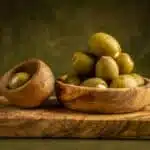
Considered one of the best in the world, it is the central ingredient. Used raw or cooked, it enhances every dish and reveals local flavors.
Seasonal vegetables, wild herbs and legumes
These foods play an essential role. Indeed, the Cretans love to eat lentils, chickpeas and broad beans, often seasoned with oregano and lemon.
Local cheeses
Local cheese dairies sell graviera directly, especially in Melanes and in the Chora markets. Several agricultural cooperatives sell vacuum-packed graviera, perfect for transport.
Amber and fragrant, honey symbolizes the island’s sweetness. It goes equally well with yoghurts and traditional pastries.
Barley bread and paximadia (dry rusks)
These breads form the basis of many dishes, including the famous dakos, topped with fresh tomatoes and feta cheese.
The Cretan art of living to the rhythm of nature
In Crete, gastronomy is above all a way of life. Here, people live by the rhythm of the seasons, respecting nature and its cycles. Each region cultivates its own specialties , perpetuating culinary traditions handed down from ancient times.
In the east
The villages of the Lassithi plateau produce fruit, honey and aromatic herbs renowned for their quality.
In the south
The olive groves stretch as far as the eye can see, offering a fruity oil with soft, balanced notes.
To the west
Around Chania, wine and carob products are enjoying a renaissance, driven by young, passionate producers.
Local markets all over the island illustrate this art of living: colorful stalls, the scent of oregano, oranges and roasted almonds. In addition, the Cretans always give priority to fresh produce and short supply chains. Cooking is part of everyday life, as is entertaining. So every meal becomes a simple celebration of taste, conviviality and shared time.
Finally, this balance between nature, health and pleasure embodies the very essence of Crete: a generous land where eating is above all about honoring life.
The small islands around Crete: hidden treasures of the Aegean Sea
Spinalonga: memory and heritage
Located in the Gulf ofElounda, in north-east Crete, Spinalonga is one of the island’s most emblematic destinations. A former Venetian fortress, it was later used as a leprosarium between 1903 and 1957. Vestiges of this period are still visible: abandoned alleyways, hospital, church and ramparts overlooking the sea.
Access
By boat from Plaka (10 min), Elounda (20 min) or Agios Nikolaos (1 h).
Summer 2025 prices
20 € for entrance to the site (official rate of the Greek Ministry of Culture) + 8 to 12 € for the crossing.
Available languages
Guided tours in English, French, German and Italian (official guide on site or multilingual audio-guide).
Board
Visit early in the morning or after 4 p.m. to avoid crowds and heat.
This island steeped in history inspired Victoria Hislop’s novel The Island of the Forgotten. A visit here is a highlight for anyone interested in Cretan history.
Chrissi Island: golden lagoon and protected nature
South ofIerapetra, Chrissi (or Gaidouronisi) is a nature reserve of rare beauty. Golden sand, century-old juniper trees and transparent waters make up this tropical setting.
Access
By boat from Ierapetra (45 min to 1 h).
Summer 2025 prices
Available languages
Guided tours in English and German; some companies offer information sheets in French and Italian.
Regulations
Daytime visits only, protected areas must be respected, no overnight stays permitted.
Tip: bring water and a hat, as the island has neither natural shade nor catering facilities.
Dia Island: silence and crystal-clear sea
Facing Heraklion, Dia is an uninhabited island classified as a Natura 2000 area, accessible only by excursion. Legend has it that Zeus transformed a dragon into stone, thus creating the island’s relief.
Access
Catamaran or speedboat from Heraklion port (approx. 45 min).
Summer 2025 prices
20 to 45 € depending on duration and boat comfort.
Available languages
Guides and crews generally speak English, sometimes French or German depending on the company.
Activities
Snorkeling, hiking, marine observation and relaxation.
Good to know : most excursions include soft drinks and snacks on board.
Gavdos: the most southerly in Europe
Facing the southwest coast of Crete, Gavdos is a charming inhabited island, considered Europe’s southernmost point.
Access
By ferry from Chora Sfakion, Sougia or Paleochora (1 h 30 to 2 h).
Summer 2025 prices
Available languages
English and German are the main languages spoken; some lodgings and taverns also welcome guests in French or Italian.
What to see
The beaches ofAgios Ioannis and Potamos, the wildest in Greece.
Tip Stay for at least two nights to experience Gavdos’ unique bohemian ambience.
Koufonissi: ancient ruins and deserted beaches
To the south-east, near Makry Gialos, Koufonissi impresses with its golden cliffs, deserted coves and Roman remains.
Access
By boat from Makry Gialos (45 min).
Summer 2025 prices
Available languages
Tours available in English and German; multilingual audioguides according to company.
What you need to know
Uninhabited island, no taverns or services. Bring water and sun protection.
Favorite: the archaeological site visible from the south coast bears witness to a flourishing Roman occupation.
Souda Island: between fortress and naval memory
In Souda Bay, near Chania, lies an island marked by five centuries of history. Souda Island was fortified by the Venetians in the XVIᵉ century to protect the port, before being occupied by the Ottomans and then used by the Allies during the Second World War.
Access
The island remains partially military, but guided tours are sometimes organized on Heritage Days or by local cultural associations.
Summer 2025 prices
Free admission during special openings; private boat excursions from Chania (approx. €20-25 per person).
Duration
Available languages
Depending on the tour, English, German and sometimes French.
From the coast or from a boat, the view of the Venetian fortress is spectacular. At sunset, the ramparts turn ochre and pink.
Thodorou: the protected refuge of the kri-kri
Opposite Platanias, fifteen minutes from Chania, lies Thodorou (or Agii Theodori), a nature reserve. It is home to the kri-kri, Crete’s endemic wild goat, threatened with extinction.
Access
The island exceptionally opens to the public at the beginning of June, during the Agios Theodoros festival.
Summer 2025 prices
Special excursions at around €20 per person, from the port of Platanias.
Duration
Available languages
English and German-speaking guides .
These supervised outings offer the chance to observe wildlife, seabirds and steep cliffs. For the rest of the year, the boats only approach to admire the landscape from the sea.
Paximadia: two golden pearls of southern Crete
Off the coast ofAgia Galini, the twin islets of Paximadia are ideal for diving and snorkeling. Their name, inspired by Cretan barley bread, evokes their warm tones and flat shape.
Access
By boat from Agia Galini or Kalamaki (about 45 minutes).
Summer 2025 prices
Between €25 and €35 depending on the company and type of excursion.
On-site time
2 to 3 hours, often with swimming and lunch included.
Available languages
English, German, sometimes Italian.
Cruises depart from April to October, when the sea is at its calmest. The translucent waters, sea caves and sandy seabed make this a popular dive site for visitors and locals alike.
Climate, seasons and best time to go to Crete
Crete enjoys a warm, sunny Mediterranean climate almost all year round. The island boasts over 300 days of sunshine a year, making it an ideal destination for all seasons.
Spring (March to June): celebrating nature
This is the best time to discover Crete without the crowds. The hills are covered with wild flowers and temperatures range from 18°C to 26°C.
Hikers can take advantage of lush green trails, particularly in the Samaria Gorge and on the Lassithi plateau.
Archaeological sites such as Knossos and Phaistos can be visited in a calm, luminous atmosphere.
Tip: the beaches start to become swimmable at the end of April, with a sea temperature of around 20°C.
Summer (June to September): warm sea and festive atmosphere
Summer in Crete is synonymous with blue skies and warm temperatures. Temperatures often reach 30-35°C, sometimes higher in the south.
Seaside resorts such as Elounda, Agios Nikolaos and Rethymnon host numerous cultural and musical events.
The sea, at around 26°C, is ideal for swimming, diving and boat trips.
Tip: avoid the hottest hours (12 pm – 4 pm) for visits to historic sites.
Autumn (September to November): softness and authenticity
Autumn offers golden light and very mild temperatures, between 22°C and 28°C.
It’s harvest season and olive oil production time. Markets fill up with local produce: grapes, pomegranates and honey.
The beaches are still calm, the sea warm and the villages serene.
Good to know: October is perfect for a gourmet or photographic trip.
Winter (December to February): mountains and culture
Winter in Crete is mild on the coast, but cooler in the mountains. Temperatures rarely drop below 12°C in Heraklion, while Psiloritis and the White Mountains are covered in snow.
This is the ideal time to discover a more intimate Crete: monasteries, taverns and museums are open, with no tourist crowds.
Tip Some mountain roads may be closed after heavy rain, so check conditions before setting off.
Best time to travel
Overall, April to June and September to October represent the best compromise between weather, crowds and price.
The landscapes are green, the sea pleasant and the roads peaceful. These periods also allow you to meet the locals in their everyday lives, far from mass tourism.
Explore Crete differently
Discoveries and experiences in the heart of the island
Discovering Crete means going beyond the beaches and famous sites. The island lends itself wonderfully to exploration, between mountains, valleys and hilltop villages.
Hiking in the gorges
The Samaria Gorge is a must-see, but theImbros andAgia Irini gorges offer equally spectacular scenery, with fewer visitors.
Mountain plateaus and villages
The Lassithi plateau, surrounded by traditional windmills, is ideal for a day trip. The surrounding villages, such as Psychro and Tzermiado, offer an insight into rural Cretan life.
Monastery visits
The monasteries ofArkadi and Toplou bear witness to the island’s religious heritage and to Cretan resistance through the centuries.
Nature observation
In spring, Crete is covered in wild flowers. This is the best time to admire orchids, prickly pears and olive trees in bloom.
Each excursion reveals a Crete that is sincere and full of character. Far from the tourist circuit, the trip becomes an immersion in a way of life where nature still guides the daily rhythm.
Maritime routes and coastal escapades
Exploring Crete from the sea offers a totally different perspective. The coasts, often inaccessible by road, abound with secret coves and picturesque fishing villages. Taking to the open sea becomes a unique way of discovering the island, between authenticity and freedom.
Private cruises
From Rethymnon or Chania, there are excursions to secluded bays such as Balos, Gramvoussa or Menies. These outings combine relaxation, swimming and local gastronomy on board, in a peaceful, friendly atmosphere.
Sailing to the smaller islands
To the south, the crossing to Chrissi Island or Gavdos, Europe’s southernmost, promises a day out of time. There, deserted beaches, turquoise waters and absolute silence offer a rare sensation of freedom.
Kayak and paddle
On the calm shores of the Libyan Sea, these activities allow you to get close to caves and cliffs while respecting the environment.
Artisanal fishing
Some excursions, led by local fishermen, offer an immersion in Cretan maritime life and a shared meal on the boat.
To extend the adventure, a day trip to Santorini from Crete offers the chance to discover another facet of the Greek islands, between volcanic cliffs and white villages suspended above the sea.
Not-to-be-missed landmarks in Crete
Crete is home to many emblematic sites, where history, culture and landscapes meet in harmony. To fully appreciate its richness, it’s best to explore the island region by region. From east to west, each part of the island unveils its own treasures, often easily accessible and pleasant to discover for a day.
Heraklion and Knossos Palace: the origins of Europe
NearHeraklion, the capital of Crete, lies the mythical palace of Knossos, the heart of Minoan civilization. Built around 1900 BC, it is considered the oldest palace in Europe. Its colorful frescoes, monumental staircases and labyrinthine layout inspired the legend of the Minotaur.
Access
15 min drive from Heraklion center.
Summer 2025 prices
Available languages
Guided tours in English, French, German and Italian.
💡 Tip: visit early in the morning or late in the afternoon to avoid the high heat.
Nearby, the Heraklion Archaeological Museum houses the world’s finest collection of Minoan art. Together, these two sites offer a complete immersion in the origins of European civilization.
Rethymnon and Chania: Venetian charm and period ambience
The towns of Rethymnon and Chania (Chania) are particularly attractive for their Venetian and Ottoman architecture.
Rethymnon
Its ancient port, fortress (Fortezza) and flower-filled alleyways invite you to take a stroll. You’ll discover a harmonious blend of minarets, churches and Venetian mansions.
Chania
Considered the most beautiful city in Crete. Its old port, lined with pastel facades, its markets and museums make it a must-see.
Travel tip: Both towns are easy to visit on foot, and have an abundance of seaside cafés. In summer, they host cultural festivals and open-air art exhibitions.
Agios Nikolaos and Elounda: elegance and sea views
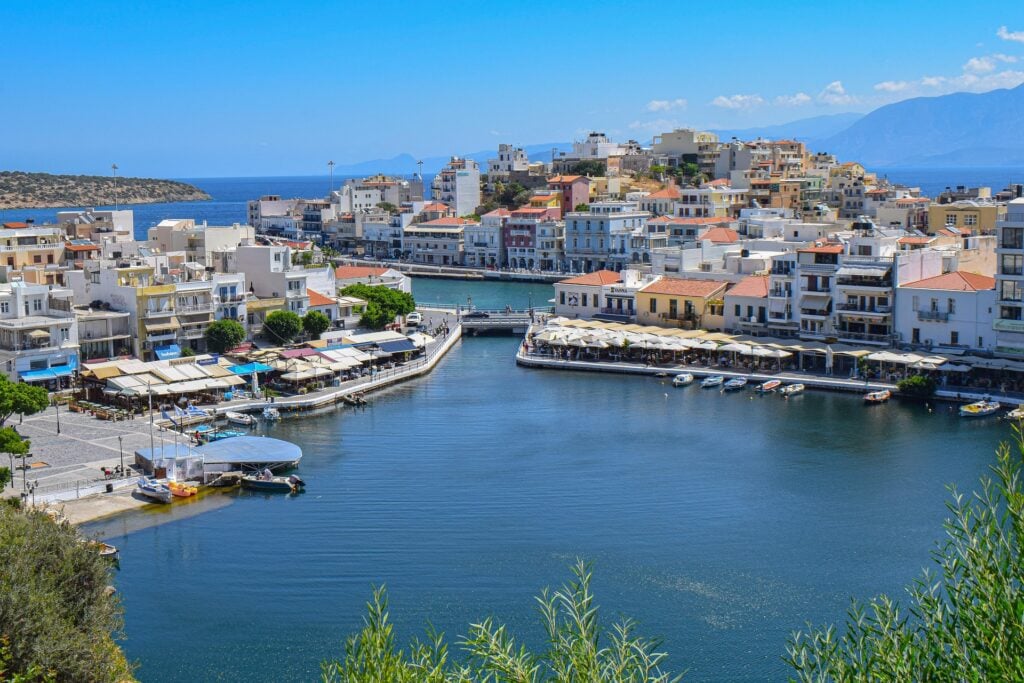
On the east coast, Agios Nikolaos offers a chic and peaceful setting around Lake Voulismeni, a small crater connected to the sea. The town is known for its art galleries and refined tavernas.
A few kilometers away, Elounda attracts visitors with its charming hotels and cruises to Spinalonga.
Access
1 h from Heraklion by coastal road.
Activities
Cruises, snorkeling, museums and walks around the lake.
Good to know: these seaside resorts are popular, but remain friendly in the off-season (May-June, September-October).
Matala and the southern caves: between sea and legend
Famous for its caves carved into the cliffs, Matala was once a Roman port, then a hippie hangout in the 1960s. Today, it retains a relaxed, bohemian atmosphere.
Access
1 h 30 from Heraklion, heading for the south coast.
Summer 2025 prices
4 € for access to the archaeological caves.
Languages
Information available on site in English and German.
Tip: come at the end of the day to enjoy the sunset over the Libyan Sea.
Lassithi Plateau: nature, villages and myths
Inland, the Lassithi plateau boasts lush green landscapes and white windmills.
What to see
The cave of Dikteon, where legend has it that Zeus was born.
Access
Approx. 1hr 30min drive from Heraklion, via Hersonissos.
Languages
On-site explanations in English and French.
This plateau, perched at an altitude of 850 meters, is surrounded by small farming villages and offers an authentic face of Crete.
Other places to explore in Crete
Western Crete: between cliffs and monasteries
Western Crete offers some of the island’s most spectacular scenery. Less touristy than the north, this region combines raw nature and spirituality.
Moni Chrysoskalitissa
This white monastery perched high above the sea dominates the Elafonissi coast. Legend has it that one of its steps is made of gold, visible only to the purest of souls. Access is free, but a small contribution is suggested.
Ancient Falassarna
Near the famous beach of the same name, you’ll discover the remains of an ancient Greek port, now partially buried under the sand. Admission is free and the site remains open all year round.
Samaria Gorge
Crete’s most famous hike. 16 km long, it traverses impressive landscapes, between cliffs and forests. Entrance to the national park costs €5, and departures are from Omalos.
Tip: plan a full day’s outing and bring good walking shoes.
Central Crete: culture and memory
The heart of Crete boasts a rich history and living traditions. The landscapes are undulating and the villages authentic.
Arkadi Monastery
The site of Cretan resistance against the Ottomans, it symbolizes the island’s freedom. Admission costs €4, and guided tours are available in English, German and French.
Eleftherna
A remarkable archaeological site with a modern museum. Located 25 km from Rethymnon, it offers an insight into the roots of Greek civilization.
Anogeia
A mountain village famous for its traditional music and textile crafts. The taverns here regularly host lyra evenings and local dances.
Tip: visit early in the morning to take advantage of the still-quiet alleyways and farmers’ markets.
Southern Crete: authenticity and wild landscapes
The southern coast, bordered by the Libyan Sea, is home to peaceful spots where nature still dominates.
Preveli Monastery
Perched above the beach of the same name, it offers a breathtaking view of the palm grove and the river that joins the sea. Admission: €3.
Triopetra
Its three giant rocks plunge into the sea, offering an impressive natural spectacle. It’s also the perfect place to watch the sunset.
Lentas
An ancient Roman port turned peaceful village. It has a spiritual atmosphere and a few family-run tavernas serving typical Cretan dishes.
Tip: the southern route is winding but superb; taking your time is part of the journey.
East Crete: ancient heritage and mild Mediterranean climate
Less visited, eastern Crete abounds in archaeological and natural treasures.
Sitia
Charming port town dominated by the Kazarma fortress. Its archaeological museum houses rare finds from the Zakros region.
Vai Beach
Famous for its palm forest, unique in Europe. The site is free of charge, with trails and panoramic viewpoints.
Zakros Palace
Fourth great Minoan palace, very well preserved. Admission costs €6, with explanatory panels in English and French.
Worth knowing: the road to Zakros passes through magnificent arid landscapes, dotted with small wine-producing villages.
Local events and festivals in Crete
Crete lives to the rhythm of its traditions, combining religion, music and gastronomy. In addition, the island’s calendar is packed with festivals throughout the year. In fact, visitors are received as guests, with a simple, deeply rooted hospitality.
Réthymnon Carnival - February
One of the oldest carnivals in Greece, known for its joyful atmosphere and costumed parades. The streets come alive with music, dance and fireworks.
Where: Rethymnon.
When : every year before Lent (February or early March).
Atmosphere : festive, family-oriented, very popular.
Tip: book your accommodation in advance, as the city is fully booked several weeks in advance.
Rethymnon Wine Festival - July
Wine is an integral part of Cretan culture. This festival, held in the municipal park, brings together local producers and traditional musicians.
And don’t forget: concerts and folk dances accompany the tasting evenings.
Olive oil festival - August
This popular festival celebrates Crete’s flagship product: olive oil. You can learn about pressing methods, local varieties and traditional dishes.
Where: Kolymbari, in the Chania region.
When: First half of August.
Atmosphere : convivial and gourmet.
Tip: this is the perfect opportunity to buy freshly produced oil direct from the mills.
Honey Festival - September
In Sitia, the spotlight is on Cretan honey. Producers offer tastings, culinary workshops and beekeeping demonstrations.
When: The first week of September each year.
Admission : free of charge.
Languages : explanations often available in English and German.
Tip: try the thyme honey, considered the most fragrant on Crete.
Religious festivals and panigyria - all year round
The “panigyria“are parish festivals celebrated in almost every village. They honor a patron saint, often with music, food and dancing late into the night.
The most important ones take place :
the August 15th (Assumption of the Virgin Mary), celebrated throughout the island;
the December 6thfor Saint Nicholas, patron saint of sailors;
the November 25thfor Saint Catherine, celebrated in Heraklion.
Note: participation is free, and visitors are always welcome.
Other cultural events
Chania Music Festival (August) Open-air concerts in the old port.
Heraklion Film Festival (June) Mediterranean cinema and Cretan documentaries.
Zoniana Cheese Festival (September) Local cheese tastings and competitions.
Cretan festivals reflect the soul of the island: generous, proud and deeply attached to its roots. To take part in one of these events is to understand what makes Crete unique – its sincere hospitality and joie de vivre.
Getting around Crete
Getting around Crete is easy, as long as you know what options are available. The island is vast: over 250 km from east to west. Choosing the right means of transport therefore depends on the type of trip you’re planning.
Getting to Crete
Crete has three main airports:
Heraklion (HER)the largest, serves the majority of international flights.
Chania (CHQ)a quieter resort, is home to many European companies.
Sitia (JSH)to the east, offers domestic and seasonal services.
In addition, regular ferries link Crete to Athens (port of Piraeus) and several islands: Santorini, Mykonos, Rhodes and Karpathos.
Tip: book summer crossings in advance, especially in July and August.
Rent a car: total freedom
Renting a car is still the best way to explore Crete at your own pace. The main roads are well maintained, and driving is pleasant outside the major cities.
Minimum age 21 years old, valid license for more than one year.
Summer 2025 prices Between €35 and €60 per day, depending on season and model.
Fuel Service stations open from 7 a.m. to 9 p.m., with guaranteed service.
Tip: compact vehicles are best for villages and mountain roads.
KTEL bus network: practical and economical
KTEL buses connect all major cities and many villages. It’s the most affordable mode of transport for travellers without a car.
Networks Two main companies – KTEL Heraklion-Lassithi and KTEL Chania-Rethymnon.
Prices from €2 (local route) to €15 (long route).
Frequency several daily departures on the Heraklion ↔ Chania and Rethymnon ↔ Agios Nikolaos routes.
Tip: timetables change according to the season, so check ktelherlas or e-ktel.
Cabs and private transfers
Cabs are available in all towns, resorts and airports on Crete. Their fares are regulated by the local authorities, although there are slight variations according to distance and area.
Average rate 2025 Approximately 1.20 per kilometer
Overnight supplement applied from 23 h
Payment cash or card depending on the driver
For added convenience, a number of approved local companies offer airport-hotel transfers or personalized routes to beaches, villages or archaeological sites.
These services often include the latest air-conditioned vehicles, a welcome at the airport with a name sign, and private or shared rides depending on demand.
A few well-known service providers:
Practical tip: always confirm the price before departure and ask for an official receipt (apódeixi). This ensures transparency and avoids misunderstandings.
Other means: bicycle, motorcycle and boat
Adventure seekers can also explore Crete in other ways.
Bikes and scooters Available in most resorts, from €15 per day.
Boat trips: ideal for reaching Chrissi, Dia, Spinalonga or Gavdos.
Organized tours Some companies offer tours combining bus, boat and walking.
Tip: in summer, prefer early morning or late afternoon rides to avoid the heat.
Practical tips for a trip to Crete
To plan a trip to Crete is already to travel a little. The island is vast and diverse, combining mountains, beaches, traditions and modernity. So, to make the most of it, it’s essential to plan your stay carefully, so as to appreciate every nuance.
When to go to Crete?
Crete can be visited all year round, but the best periods are April to June and September to October.
The climate is mild, the countryside green and the sites less crowded.
Summer (July-August) is perfect for beach lovers and local festivities, but the heat often exceeds 35°C.
In winter, the north remains pleasant, while the central mountains are covered in snow.
Astuce: book early in high season; direct flights and ferries sell out weeks in advance.
How many days should I allow?
For a first approach, 7 to 10 days are enough to discover the main sites: Heraklion, Rethymnon, Chania and a few emblematic beaches.
A two-week stay also allows you to explore the mountain villages and nearby islands.
For a short stay, it’s best to concentrate on a single region to avoid long journeys.
Tip: Crete is over 250 km long from east to west; crossing the whole island in a few days is not realistic.
Getting around
The most practical way to explore Crete is by car. Main roads are in good condition, but some secondary roads can be narrow or winding.
The KTEL bus network serves the main towns and many villages, with extra services in summer.
Regional ferries also provide connections to neighboring islands such as Santorini and Karpathos.
Tip: it’s best to fill up before venturing into mountainous areas, where service stations are scarcer.
Where to stay?
Crete offers a wide range of accommodation: family-run hotels, guest houses, villas or charming establishments. Each region offers a different atmosphere, to suit every style of traveller.
Heraklion Heraklion: ideal for lovers of culture and ancient sites, the capital offers easy access to the great Minoan remains.
Rethymnon Rethymnon: perfect for a romantic getaway, this charming Venetian town boasts lively alleyways and a bohemian atmosphere.
Chania Chania: renowned for its picturesque port, it offers quick access to the most beautiful beaches in the west, between coves and turquoise lagoons.
The south coast The south coast: wilder and more peaceful, it attracts travelers in search of authenticity and unspoilt nature.
Finally, choosing accommodation run by Cretan families often guarantees a warmer welcome and invaluable advice on how to discover the island in a different way.
Local tips and times to avoid
The Cretans are known for their hospitality and sense of sharing. Thus, greeting on entering a shop and adopting a relaxed pace are always appreciated gestures.
In summer, however, it is advisable to avoid the hottest hours, between 12 noon and 4 p.m., for visits or travel. What’ s more, certain tourist areas such as Elounda and Balos become very busy in July and August.
In spring and autumn, on the other hand, the scenery is sublime and the atmosphere more serene. These seasons are ideal for those seeking a more authentic experience, close to nature and the local way of life.